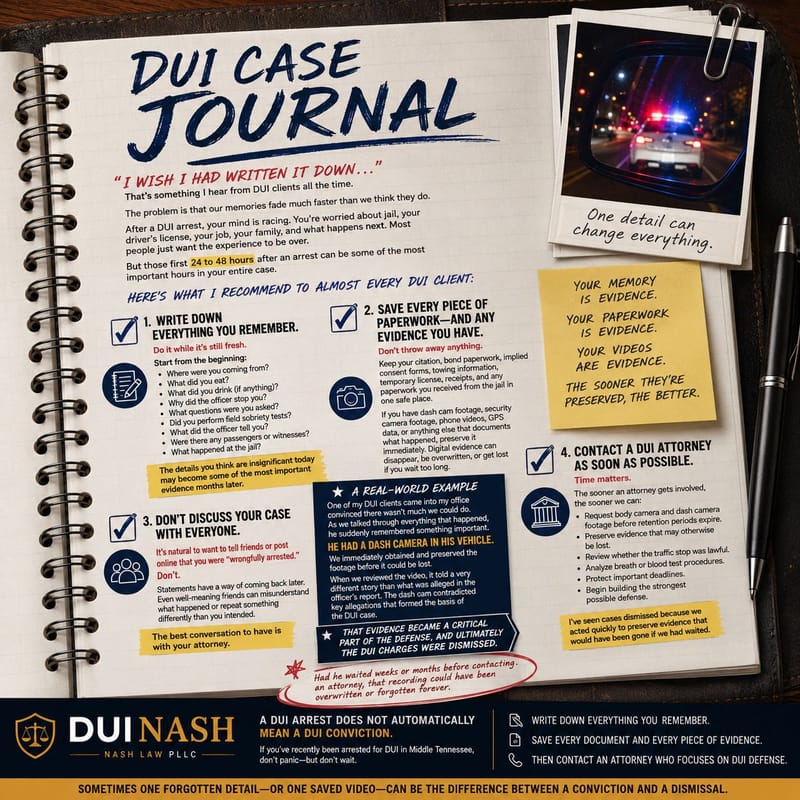
That's a common sentiment I hear from DUI clients all the time.
The problem is, our memories fade much faster than we think they do. After a DUI arrest, your mind is racing. You're worried about jail, your driver's license, your job, your family, and what happens next.
Most people just want the experience to be over. But those first 24 to 48 hours after an arrest can be some of the most important hours in your entire case.
Here's what I recommend to almost every DUI client.
Write Down
Do it while it's still fresh. Start from the beginning and try to recall every detail:
Where were you coming from?
What did you eat?
What did you drink (if anything)?
Why did the officer stop you?
What questions were you asked?
Did you perform field sobriety tests?
What did the officer tell you?
Were there any passengers or witnesses?
What happened at the jail?
Look, the details you think are insignificant today may become some of the most important evidence months later. Don't underestimate the power of your own memory, especially when it's fresh.
Save Evidence
Don't throw away anything. You'll want to keep all related paperwork in one safe place. This includes your citation, bond paperwork, implied consent forms, towing information, temporary license, receipts, and any other documents you received from the jail.
And if you have dash cam footage, security camera footage, phone videos, GPS data, or anything else that documents what happened, preserve it immediately. Digital evidence can disappear, be overwritten, or get lost if you wait too long.
Don't Discuss
It's natural to want to tell friends or post online that you were "wrongfully arrested." But don't. The best conversation to have is with your attorney. Well-meaning friends can misunderstand what happened or repeat something differently than you intended.
Here's a real-world example: One of my DUI clients came into my office convinced there wasn't much we could do. As we talked through everything that happened, he suddenly remembered something important. He had a dash camera in his vehicle. We immediately obtained and preserved the footage before it could be lost. When we reviewed the video, it told a very different story than what was alleged in the officer's report. The dash cam contradicted key allegations that formed the basis of the DUI case. That evidence became a critical part of the defense, and ultimately the DUI charges were dismissed. Had he waited weeks or months before contacting an attorney, that recording could have been overwritten or forgotten forever.
That's why I tell clients: Your memory is evidence. Your paperwork is evidence. Your videos are evidence. The sooner they're preserved, the better.
Contact Attorney
Time matters. The sooner an attorney gets involved, the sooner we can:
Request body camera and dash camera footage before retention periods expire.
Preserve evidence that may otherwise be lost.
Review whether the traffic stop was lawful.
Analyze breath or blood test procedures.
Protect important deadlines.
Begin building the strongest possible defense.
I've seen cases dismissed because we acted quickly to preserve evidence that would have been gone if we had waited.
A DUI arrest does not automatically mean a DUI conviction. If you've recently been arrested for DUI in Middle Tennessee, don't panic—but don't wait.
Sometimes one forgotten detail—or one saved video—can be the difference between a conviction and a dismissal.
Write down everything you remember. Save every document and every piece of evidence. Then contact an attorney who focuses on DUI defense.